Byron and Freedom
The Greek Revolution, the ‘Romantic Revolution’ and the making of the modern world
Almost two hundred years ago, on April 10, 1826, the defenders of Messolonghi made their final, desperate exodus from the besieged Greek town—an event that would echo through history as one of the defining moments of the Greek Revolution. Just two years earlier, Lord Byron had died in this same town, his death marking not only the end of a revolutionary literary life but also a turning point in the struggle for Greek independence.
Now, as we approach the bicentennial of that fateful exodus, scholars and students have an extraordinary opportunity to explore these interconnected legacies at the 16th International Student Byron Conference, taking place May 21-27, 2026, in Messolonghi at the beautiful Messolonghi Research Center for Byron and Philhellenism.
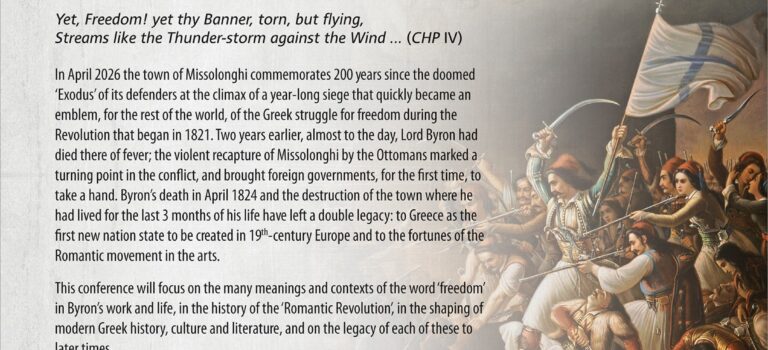
Yet, Freedom! yet thy Banner, torn, but flying,
Streams like the Thunder-storm against the Wind . . . (CHP IV)
Hosted by the Messolonghi Byron Society and Byron Research Center, this conference promises to be more than just another academic gathering. The theme “Byron and Freedom” couldn’t be more timely or significant.
The conference will explore how Byron’s concept of freedom influenced not just literature, but the very formation of modern Europe. Greece became the first new nation-state created in 19th-century Europe, and Byron’s death there helped galvanize international support for the Greek cause. This intersection of Romantic literature and political revolution offers rich territory for scholarly investigation.
A Wealth of Research Opportunities
The organizers are seeking proposals that address the many dimensions of freedom in Byron’s work and its historical context. Whether you’re interested in:
- International politics and philhellenism – How did Byron’s involvement shape foreign support for Greek independence?
- Domestic British politics – What was Byron’s role in “freedom’s battle back in England”?
- Revolutionary movements – Byron’s connections with the Carbonari offer fascinating insights into underground resistance networks
- Media and censorship – Byron’s struggles with press freedom remain remarkably relevant today
- Literary legacy – How did later writers and artists inherit and transform Byron’s libertarian ideals?
- Interdisciplinary approaches – Visual arts, music, and drama all offer unique perspectives on Byron’s themes
The conference welcomes diverse methodological approaches and encourages participants to think broadly about how the “Romantic Revolution” helped shape our modern world.
An Immersive Historical Experience
Messolonghi isn’t just a conference venue—it’s a living memorial to the ideals Byron died supporting. Walking the streets where Byron walked, scholars and students can engage with history in an immediate, tangible way that’s impossible to replicate in a traditional academic setting.
The town’s commitment to preserving and understanding their history, evident in the work of the Messolonghi Byron Society, ensures that participants will have access to unique resources and local expertise.
Call For Papers
New proposal Deadline: February 27, 2026 to:
For those unfamiliar with the International Student Byron Conference series, detailed descriptions of previous conferences are available on the Messolonghi Byron Society’s website at www.messolonghibyronsociety.gr.
Whether you’re a student just beginning to explore Romantic literature, an established graduate student with new insights to share, or someone working in adjacent fields like history, political science, or the arts, this conference offers a unique platform for meaningful scholarly exchange.
Byron’s vision of freedom continues to resonate in our contemporary world. As we face our own struggles for liberty, justice, and human dignity, examining how the Romantic Revolution helped shape modern political consciousness becomes not just an academic exercise, but an urgent contemporary inquiry.