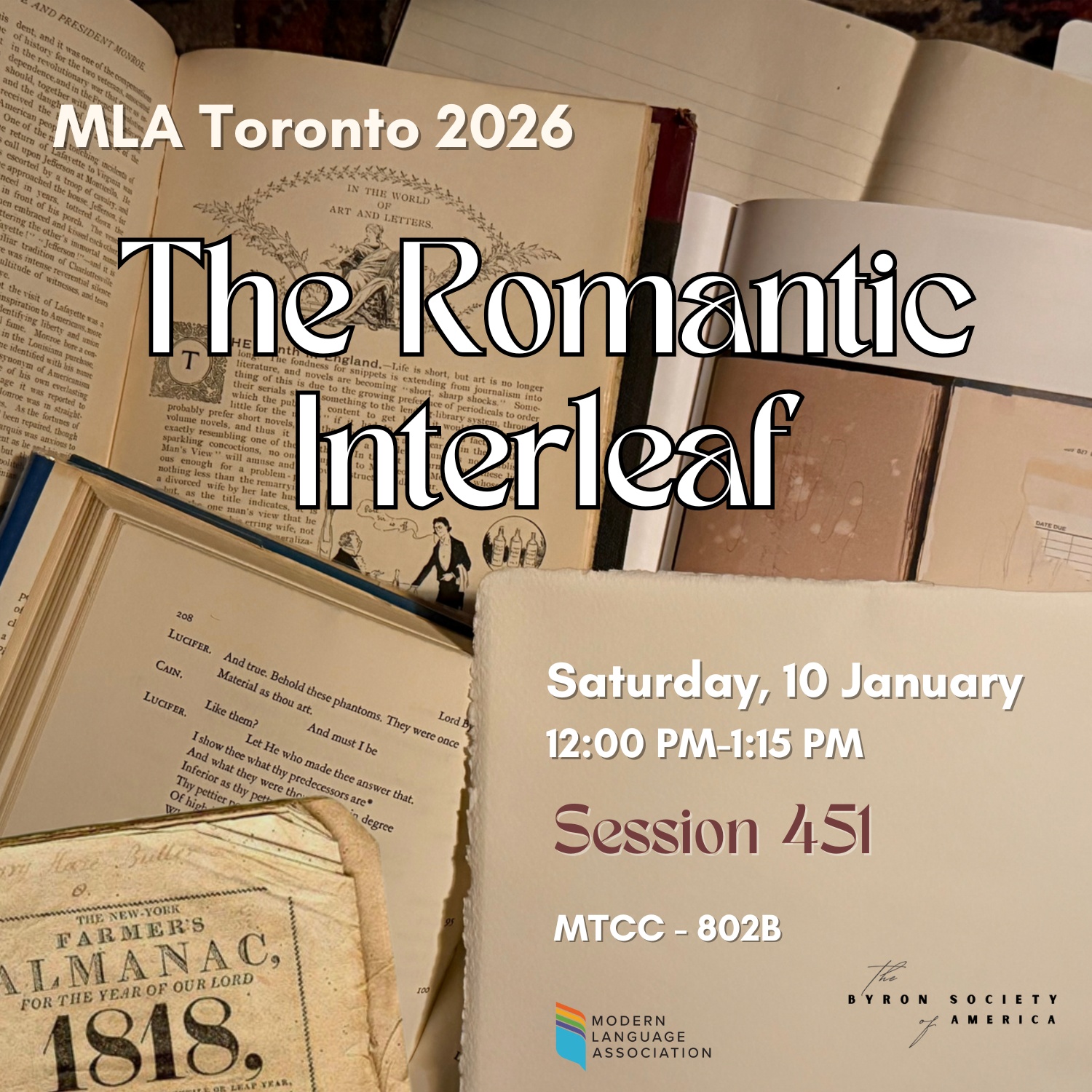
The Byron Society of America is looking forward to the MLA’s 2026 convention in Toronto where we will feature a distinctive roundtable session that examines a fascinating—yet often overlooked—aspect of nineteenth-century book culture: the practice of interleaving. Presided over by Ruth Abbott of the University of Cambridge, “The Romantic Interleaf” brings together six scholars to explore the transformation of texts from fixed publications into evolving records by unbinding, rebinding, or tipping in leaves through other means.
Centering on the physical intervention readers made in their codexes and reflecting on how interleaving functioned within particular genres of the period more broadly, this roundtable explores the printed book as hybrid objects through the intimate reading practices and knowledge-making processes of texts, manuscripts, circulation, and personalization.
Emily Senior will present on Caribbean interleaved almanacs, drawing on her expertise in eighteenth-century and Romantic colonial cultures and her current work on a Caribbean history of the book. Andrew Stauffer will discuss interleaved items from the Book Traces project, incorporating actual leaves from nineteenth-century books. Deidre Lynch will examine interleaved theatrical lives, bringing her extensive knowledge of reading history and books in pieces to bear on performance culture. Lucy Sixsmith will explore interleaved bibles, extending her research on how nineteenth-century readers handled and used their Bibles as both objects and texts. Michael Macovski will investigate interleaved copies of Byron, connecting his longstanding interest in print culture and nineteenth-century literary celebrity. Dahlia Porter will analyze interleaved catalogues, building on her research into the organization of knowledge and the cultural power of inventories and catalogues from 1750 to 1850.
The roundtable format allows ample time for discussion between panelists and audience members, fostering the kind of collaborative exchange that characterizes the most productive conversations we all enjoy. By examining interleaved books across diverse genres—from almanacs and bibles to theatrical biographies and literary catalogues—the session illuminates how readers across different social contexts and reading communities engaged with print culture through material intervention. These interventions speak to broader questions about agency, knowledge production, and the social life of books in an era of rapidly expanding print circulation.
About the Presenters
Deidre Lynch is Ernest Bernbaum Professor of English Literature at Harvard University, where she teaches courses on the history of reading, book theory, Jane Austen and fan cultures, and the Gothic tradition. Her scholarship often works at the intersection of literary criticism and the history of the book, particularly examining books in pieces—the notes, scraps, and paper slips that challenge the fixity of the printed codex. She has written about blank books, pins in books, handwritten copies of printed books, ephemera, and paper art and craft, as well as publishing extensively on the history of the British novel from Daniel Defoe to Ali Smith. Lynch’s research has been supported by fellowships from the National Humanities Center, the Guggenheim Foundation, and the National Endowment for the Humanities. She received the Modern Language Association’s First Book Award in 1999, and in 2024, the Keats-Shelley Association of America awarded her its Distinguished Scholar Award for lifetime achievement. Harvard’s graduating classes have selected her as a favorite professor on six occasions, and in 2021 she was appointed Harvard College Professor in recognition of her excellence in undergraduate teaching.
Michael Macovski is Professor in Georgetown University’s Communication, Culture & Technology program, where his teaching and research focus on print culture within the history of technology. He studied at UC Berkeley as an undergraduate, working with novelist David Lodge in England before completing his graduate work at Berkeley. He taught at Dartmouth and Fordham University before joining Georgetown. Macovski is the author of two books: Dialogue in Literature and Dialogue and Critical Discourse: Language, Culture, Critical Theory. His ongoing interest in nineteenth-century literature encompasses figures like William Blake, who invented his own print technology and forms, and Lord Byron, who became an international celebrity partly through his knowledge of new print culture advances. Macovski’s research explores how nineteenth-century developments in print technology, particularly the steam press, revolutionized textual and image reproduction and dissemination, creating phenomena that resonate with contemporary digital culture. He serves as faculty advisor to Georgetown’s Global Media Group and actively mentors students pursuing conference presentations and doctoral programs.
Dahlia J. Porter is Professor of English Literature and Material Culture, University of Glasgow. A native of Buffalo, New York, she received her BA from New York University, her MA from the University of Illinois at Urbana-Champaign, and her PhD from the University of Pennsylvania. Before joining Glasgow in 2017, she taught eighteenth-century and Romantic literature at Vanderbilt University and the University of North Texas. Porter’s research focuses on the organization of knowledge and literary form in the eighteenth and nineteenth centuries. Her first book, Science, Form and the Problem of Induction in British Romanticism, 2018 from Cambridge University Press, argues that the formal mixtures definitive of Romantic literature arose when authors applied the inductive method of experimental science to literary composition. She is currently completing a second monograph, provisionally titled The Poetics of Inventory, which investigates the cultural and epistemological power of catalogues and inventories from 1750 to 1850, analyzing how these utilitarian forms functioned as conduits between scientific and aesthetic spheres of thought and practice.
Emily Senior is Associate Professor in the Faculty of English at the University of Cambridge, where she arrived in 2023 after serving as Reader in Eighteenth-Century and Romantic Literature at Birkbeck, University of London. She also taught previously at the University of Warwick and the Open University. Senior’s research interests center on eighteenth-century and Romantic writing and colonial cultures, with particular focus on Caribbean and Atlantic literature, visual culture, and the life sciences. She is currently working on a Caribbean history of the book and on a project exploring colonial collections and digital archiving that seeks to uncover details of Black and Indigenous naturalists and collectors. Her monograph The Caribbean and the Medical Imagination, 1764-1834: Slavery, Disease and Colonial Modernity (Cambridge University Press, 2018) won the University English Book Prize 2019. Her work is driven by two aims: to forge alternate genealogies and critical frameworks for eighteenth-century literatures by reading in global terms that account for colonial modernity, and to reformulate debates about disciplinarity by examining how literature shapes other ways of knowing the world.
Lucy Sixsmith is a Title A Research Fellow at St John’s College, University of Cambridge. She studied English at Cambridge, graduating in 2010, and worked as an English language teacher in Russia, Italy, and the UK before returning to Cambridge in 2017. She completed her PhD, “Handling Bibles in the Nineteenth Century,” at Trinity College in 2023. Sixsmith’s research explores what people do with books and what happens when they read, focusing particularly on the nineteenth century when industrialization made books and print cheaper and more ubiquitous. Her work examines the use of books as objects as well as texts, focusing on nineteenth-century bibles and the unexpected biographies behind the signs of use they still contain. She is interested in evangelical history, charismatic movements, worship and spiritual abuse, and her trade book When the Music Fades: Power, Surrender and the Soul Survivor Generation is forthcoming with Canterbury Press in 2026. Her published work has appeared in Book History, Textual Practice, and The Cambridge Quarterly, examining topics from bible transactions in Britain and Antigua to reading practices in nineteenth-century English prisons.
Andrew M. Stauffer is Professor and Chair of the Department of English at the University of Virginia. He is the author of Byron: A Life in Ten Letters (Cambridge, 2024) and Book Traces: Nineteenth-Century Readers and the Future of the Library (University of Pennsylvania Press, 2021), which won the inaugural Marilyn Gaull Award for scholarship in Romanticism. His other publications include Anger, Revolution, and Romanticism (Cambridge, 2005) and editions of works by Byron, Robert Browning, and H. Rider Haggard. Stauffer received his BA from the University of Pennsylvania and his PhD from the University of Virginia. He held fellowships from the American Council of Learned Societies, the National Endowment for the Humanities, the New York Public Library, the Huntington Library, and the Bibliographical Society of America, and has received research grants from the NEH and the Andrew Mellon Foundation. Since 2013, he has served as President of the Byron Society of America.Ruth Abbott (Presiding) is Associate Professor in the English Faculty at the University of Cambridge and a Fellow and Director of Studies at St John’s College. She held fellowships at Cornell University, Oxford, the Centre for Research in the Arts, Social Sciences, and Humanities at Cambridge, Villa I Tatti in Florence, the Huntington Library, and the Beinecke Library at Yale. Abbott’s research and teaching focus on textual scholarship and eighteenth- and nineteenth-century manuscripts, particularly notebooks and the history of note-taking, with emphasis on compositional practices, reading practices, research practices, and the history of scholarship. She serves as editor, with Michael Rossington, of The Poems of Wordsworth for the Longman Annotated English Poets series (Routledge) and has created digital editions of Thomas Gray manuscripts for the Cambridge Digital Library. She is currently completing a three-volume edition of and monograph about George Eliot’s scholarly notebooks. Abbott received CUSU student-led teaching awards for both supervising and lecturing, as well as a University Pilkington Prize for excellence in teaching.